 Luca
LucaHow a photo becomes four numbers
The scan takes seconds. Here is what happens in them, what the result can and cannot tell you, and how to get closer.

The scan, step by step
Frame the meal
Open the camera in Luca and fit the whole meal inside the square frame. If no meal is in view, the camera gently says so; that check happens on your phone.
Take the photo
The photo is sent over an encrypted connection to servers the developer operates. It is analysed and not stored.
Read the estimate
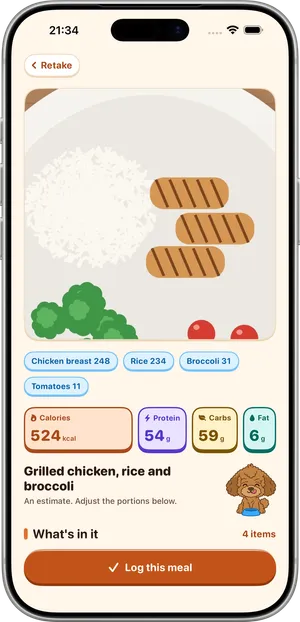
In seconds you get a list of the foods Luca saw, with an estimate of calories, protein, carbs and fat for the meal. When Luca is unsure, it asks one quick question about the portion.
Correct it
Change a portion with the plus and minus buttons, or use Fix with words: type a sentence such as "the rice was brown, no butter" and Luca updates the result. Up to 5 fixes per meal; fixes do not use a scan. Luca learns your usual portions from your corrections, on your phone.
Log it
Log the meal. It is stored on your iPhone and counts toward your daily ring and macro targets.
Said plainly
What "approximate" means
A photo result is an informed guess. It is useful, and it is not a weighed amount.
To put numbers on a plate, three things have to be worked out: what the foods are, how much of each there is, and what is in them. A photo helps most with the first. It helps less with the second, because a flat picture does not show how much is piled up or what it weighs. It cannot help with the third at all when the answer is a recipe: the oil in the pan, the cream in the sauce, the sugar in the glaze.
So expect a photo estimate to be in the right neighborhood for simple, visible food (a banana, a boiled egg, a slice of toast) and looser for mixed, sauced, fried or layered dishes. The more of the meal is hidden, the more the number is a guess.
That is why Luca calls the result an estimate every time, shows you the item list it is built from, and lets you change every item and number. We do not publish an accuracy percentage, because no single figure would be true for every meal.

Seven habits
How to make estimates closer
Get the whole plate in the frame
Food that is cut off at the edge is food Luca has to guess at.
Shoot from above or at an angle, in good light
Shadows and steam hide things. Daylight or a bright room helps.
Spread things out
What sits under something else cannot be seen. If the rice is under the curry, say so in the item list.
Add the invisible, in words
Cooking oil, butter, dressings, sugar in drinks. No camera can see them. Fix with words lets you just say so: "cooked in a tablespoon of olive oil".
Fix the portion you know
If you know it was two eggs, or 150 g of pasta, type that. One corrected item improves the whole meal.
Use the barcode for packets
A label states the numbers. A photo is a guess. For packaged food, scan the barcode, or let Luca read the nutrition label if the barcode is not found.
Save what you corrected
Mark a corrected meal as a favorite and the next time is one tap, with your numbers. Luca also learns your usual portions from your corrections, on your phone.
More on this in how to estimate portions and how photo calorie estimation works.
Where the numbers come from
Two jobs, done separately, and one fallback.
What and how much
Luca's AI works out what the food is and how much of it there is. When it is unsure, it asks one quick question about the portion.
Calories and macros
Where the food is recognised, calories and macros are calculated from a nutrition database of more than 10,000 everyday foods and dishes.
When a food is not recognised
When a food is not recognised in the database, Luca uses its own estimate for that item and treats the result as less certain.
A database value applied to an estimated portion is still an estimate.
Where the photo goes
Three stops. The longer version
- Your iPhoneYou take a photo of a meal in the square frame, say it, or type it. The camera's hint that no meal is in view is worked out on the phone.Nothing has left the phone yet
- Luca's own serversThe photo, the text or up to 20 seconds of voice audio is sent over an encrypted connection and processed on servers the developer operates. No third-party AI provider.Processed, then not stored
- Back on your iPhoneThe estimate comes back: an item list with calories, protein, carbs and fat. You edit it and log it.Meals are stored on your device, and in your iCloud if you use it
When a photo is the wrong tool
Packaged food
Scan the barcode. The numbers come from label data. More
The plate is already empty
Say it or type it. A short description gives the same editable item list. More
The same thing as yesterday
Log it again from recent or favorite meals with one tap. More
Luca gives estimates for general information. It is not a medical device and does not give medical or dietary advice.
Questions about the scan
How does Luca estimate calories from a photo?
Luca's AI works out what the food is and how much of it there is. Calories, protein, carbs and fat are then calculated from a nutrition database where the food is recognised. When a food is not recognised in the database, Luca uses its own estimate for that item and treats the result as less certain. The result comes back as an item list you can edit.
Where do Luca's nutrition numbers come from?
From a nutrition database of more than 10,000 everyday foods and dishes, where the food is recognised. When a food is not recognised in the database, Luca uses its own estimate for that item and treats the result as less certain. For packaged food scanned by barcode, the numbers come from label data. Because the portion is estimated, the result is still approximate.
Why is a photo estimate only approximate?
Because a photo leaves things out. It cannot show hidden fat and sugar, how full a bowl is, what is under the top layer, or the recipe. Two plates that look the same can differ a lot. That is true of any photo-based estimate, not only Luca.
Does Luca publish an accuracy figure?
No. Accuracy depends on the meal, the photo and what cannot be seen, so a single percentage would mislead. Luca labels photo results as estimates and makes every number editable.
What is the most reliable way to log in Luca?
For packaged food, the barcode, because the numbers come from label data. For home cooking, a photo or description that you then correct with what you know: the portions you weighed or counted and the oil you used.
Is my photo kept after the scan?
Not on the server. The photo is sent to be analysed and is not stored there. Your meals are stored on your iPhone, and in your own iCloud if you use it.